Showing posts with label sketchup. Show all posts

Tuesday, May 24, 2016

Arts & Crafts End Table Design

It happens every time I design something and walk away for a few months.  When I finally look at the idea again, it's not quite good enough.  

Make a bunch of cubic rectangles and put them together, right?


This was my first "final" draft.

My original "final" design from several months ago.
It didn't take long for me to get sick of it.  It's too blocky, too thick.  It needs refining.

Spindles!  Just say no!


I spent another week on it and came up with a spindle version which became the next "final" draft.

Final Draft #2
I added a bevel to the underside of the top to lighten things up a bit, played around for awhile trying to find a spindle pattern that wasn't too plain, removed the double tenons and added a slotted dovetail drawer blade.   This remained for 3 or 4 months as the plan.

Fast-forward to today.  I opened the Sketchup model again and can't shake the feeling that I still hate how boxy and heavy it looks.  I also hate dusting between spindles and swore I'd never build spindle furniture.  I thought it needed something, but this isn't it.  It's too dark, too heavy, too boxy.

Fix it! But how?

One proven strategy for lightening the look of pieces like this is to taper the legs, but no.  I'll save that for the Shaker bedroom set I'm going to build for the boys.

Flare the legs out?  Definitely not.  For our taste, some of the Mackintosh pieces are too wide-bodied, and the Asian-inspired Arts & Crafts fusion isn't our bag.

The main reason we avoid these more vocal styles is that we're trying to find a universal aesthetic that fits with the rest of our home, even as styles change.  The end tables need to match the coffee table (already built) and everything needs to blend in with craftsman, rustic, lodge or whatever decor my wife decides to fill the room with.

A lot of Arts & Crafts furniture is big, boxy, heavy, bulky, strong, solid.  I think the real exercise here is to stay within the Arts & Crafts genre, but be as airy and lightweight as possible.  This is probably why we lean toward the Harvey Ellis style with his graceful and uplifting arcs.

I spent a good few hours today nudging things around.  I decreased the thickness of the top from 1" to 3/4" and that lightened it quite a bit.  I raised the skirt to add a bit more air underneath and deepened the arcs to increase the uplifting effect.  Instead of having a plank spanning the entire width of the table, I left room on each side to let even more air and light through.

At one point I had the plank through-mortised into the front and back skirts, but decided it added too much noise, drawing too much attention to itself.

Through-tenons on the plank.  I found it distracting.

We're trying to maintain a bird's eye view of the entire living room set across several years of separation (as I'm rather slow at building things).  Every stylistic decision here would have to carry through to the other pieces of my living room set.  So she also vetoed the Limbert-style gridwork plank approach I toyed around with at one point, too.

The latest "final" draft.
 Right now I feel pretty good about this.  I'll let it simmer for a week and come back to it with fresh eyes and see if it needs more tweaking.  Lots of Golden Ratio dimensioning again, because it's fun.  In the future I want to play around with Jim Tolpin's By Hand & Eye approach.


Tuesday, May 3, 2016

Q&A - What would I do differently?

Round 3 of Brady Kirkwood's Q&A for the Jewelry Armoire / Lingerie Chest build he's going to undertake.  He graciously agreed to let me publish his questions alongside my answers in case anyone else finds use in them.

Question #3


What would you do differently, either in the making or the design? 
What would you do to make the assembly easier?


My Response: 


I wrote up a "What Went Wrong" summary at the end of the project.  I'll pull some from there.

  • I never replaced those phillips-head screws for the back panels like I said I was going to.  I got too tired and didn't want to wait for an order of screws.  Note to Chris Schwarz: don't look back there.
  • The aniline dye bled into the maple drawer sides.  I attempted to tape these off to keep them pristine, but it didn't work out.  Next time I'll prefinish the drawer fronts and then assemble.  Then when I'm fitting the drawers, I'll just plane their end grain off.  If I go in carefully with a paintbrush I might be able to just darken them a bit without it bleeding into the maple.  The only other method I can think of is to make my dry-fit as close to the drawer opening as possible so I don't have to remove any material.  Not sure how I feel about this approach.
  • I continue to have trouble with drawbore pins blowing out the grain on the far side.  Quartersawn White Oak is brittle in parts, so that certainly doesn't make it any easier, but I need more practice.  I've solved this on the Flip-Top Table build.  Basically I use less of an offset for Quartersawn White Oak (1/64" to 1/32" maximum), and I spend a lot of time making the tips of my drawbore pegs perfectly hemispherical.  I used to sharpen them to a pencil point, but the point was catching the grain on the far side instead of sliding past, forcing a blow out.  I tried flattening the sharp point, but it wasn't enough.  I looked very closely at the pegs in Doucette & Wolfe's Trestle Table Build video and noticed his tips were much rounder than mine, so I went that route and it worked perfectly.  Also, I use my rattail rasp to file the entry hole on the breadboard tenon so that it has a bit of a chamfer.  This helps guide the peg into the tenon hole.  And finally, hide glue lubricates the peg as it goes in where Titebond II does not.  My best advice is practice on scrap until you get it right consistently.  If it fails, it fails catastrophically.  :P
  • I kinda wish I made narrower pins in the dovetails.  These look like they could have been made by a machine router bit.  I was super nervous going into that phase of the project so I gave myself extra room to screw up, but I think I've got the hang of it now and can start leveling up my dovetails.
  • The top isn't perfectly flat because my workbench wasn't perfectly flat.  It's close though.  If I were to build another bench I don't think I'd bother with the split-top.  One solid surface seems like I'd enjoy it better.  Add it to the list!
  • I took a bit too much wood off a few of the drawer sides when fitting them, removing the possibility of a piston-fit.  I had to glue some thin shims to the drawer guides in the lower drawer bays and then plane them back down until the larger drawers stopped jamming.  I admit I was impatient at this point and wanted the drawers in and done, but this is the worst kind of mistake after all this work.  It's so important to slow down here and take super light passes and keep retesting the fit over and over again.  Once you go too far it's too late.
  • My drawer closing stops were positioned too close to my drawer guides, thus preventing my large shoulder plane from fitting in there to tune the drawer guides like I intended.  I could have bought a smaller shoulder plane, but I chose not to.  If I had it to do over, I would have used a rabbeted guide as Mario Rodrigues does (See Popular Woodworking - February 2009 - Issue #174 - 7 Strategies for Better Drawers).  
  • I should have planned the assembly better in the design phase.  I think the main carcass glue-up exceeded 70 parts.  I did a ton of dry-fit practice runs beforehand, but still... stressful isn't the word.  Also, despite them fitting perfectly during the dry-fit, the sliding dovetail webframe fronts didn't seat flush with the legs.  They're probably 1/128" - 1/64" proud of the surface.  I beat on them with a mallet really hard, but no luck.  And since they were pre-finished, I couldn't plane it flush after assembly.  Maybe I won't pre-finish this type of assembly next time for this very reason.
  • I still hate machine routers.  I had to use it for the 52" long lock miters in the legs.  If I can figure out a way to do this by hand, I'll probably do it.  It'll be safer, quieter, slower, and with less potential for grain explosions.

New addition to the list, after living with the dresser for a couple years and looking at it every day....

The front drawer blades are displaying flat sawn grain.  I find this incredibly distracting.  I really wish I trimmed a piece off, rotated it and glued it back on so that these blades would display quarter sawn grain to the viewer. 


To Simplify the Assembly Phase


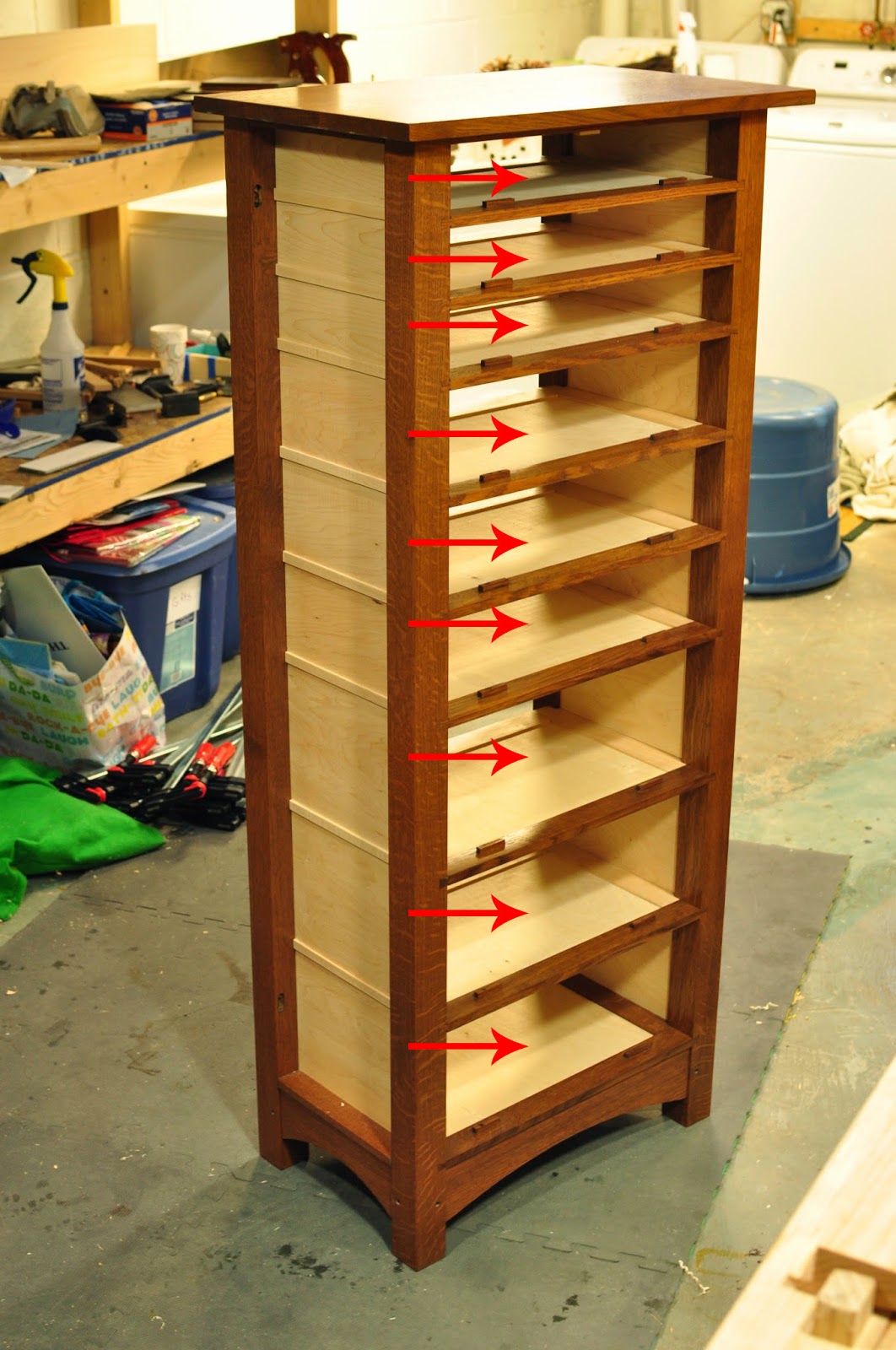
With integral side panels, I can't really think of a way to simplify the assembly.  Reason being: you can't put those side panels into their slots without putting all of the web frames and all of the legs together in a single glue-up.  More than 70 parts in a single glue up.  Woo!

My advice is to dry-fit as many times as it takes until you memorize the order.  Tune the fit of every joint that shows the first sign of binding.  The time to tune isn't when the glue is on.  :)  

Although... 

If you choose to not do the side panels, you can do an initial assembly of legs + top frame + skirts.  That will lock in the core length / width / depth dimensions of the entire piece.  Then you can take your time and put in one web frame at a time.  A much more methodical and relaxing process


Hmm...  perhaps there's another way to get those side panels in after the fact.  Maybe treat them like glass panels.  Put them in place after the initial glue-up and then tack or glue on a little strip of wood to hold them there and to hide the edges of each panel.  Like so... hm..... wait... no.  Never mind.  

If you're going to put the side panels in after the fact, you might as well just put one tall panel the size of the door bay.  Or even better, you could do thin, narrow, shiplapped planks in there running vertically.  That would certainly simplify the main carcass assembly, allowing you to break it out into stages.  It also maintains a consistent overall aesthetic.  Not too shabby!


Stage 1: Legs + Skirts + Top Frame + Back (and Side) Mounting Strips (something to screw or nail the shiplapped planks into)

Stage 2: Glue and tap in one web frame at a time.  They are pretty much self-clamping, especially with the plywood panels holding them to their exact width, pressing them into the leg notches.

Stage 3: Screw or nail on the shiplapped planks onto the back and inside the door bays

Stage 4: Glue on the rabbeted Drawer Guides, attach the Top

Stage 5: Make and mount the Doors & Hinges, tune the fit

Stage 6: Make & fit the Drawers

Stage 7: Attach the Drawer Stops, Door Catches, Knobs 

There's probably more, but this is off the top of my head...

By removing the side panels and their captive grooves, you will be able to reduce the width of the web frame sides, as some of that material is now unnecessary.  This will allow you to have 3/8" thick shiplapping for the door bays and end up with the same internal volume I did.  But if it were me, I'd make 1/4" thick shiplapping, as every bit counts in that cramped space.


I spent a lot of time trying to figure out a way to maximize the storage space in there without sacrificing wood strength or creating weak wood joints.  The easiest option is to have wider legs, pushing the doors out farther, but I wanted to keep it looking as slender as possible.  It's a tight space and a difficult puzzle to solve.

Q&A - Side Panels between Drawer Web Frames


Round 2 of Brady Kirkwood's Q&A for the Jewelry Armoire / Lingerie Chest build he's going to undertake.  He graciously agreed to let me publish his questions alongside my answers in case anyone else finds use in them.

Question #2 

If making the project again, would you put the panels in all the web frames between drawers or just keep them open? (you might be able to tell, I am trying to cut down the sheer number of piece parts in this project)


My Response:


I would.


Firstly, because I don’t want dangling necklaces or earrings to fall into the drawer bays.  


Secondly, I was super enamored with one of Tom Fidgen’s builds in his book Made By Hand.  


I took a lot of inspiration from that project.  He had a SketchUp model at one point, and I was able to dissect it piece by piece to see how he put it together and walk through the joinery decisions he made.  It was fascinating and is probably one of the most efficient ways I've found for learning complicated carcass joinery methods.

The beauty of the thin panels suspended in those web frames with no glue was just such a clean look and really added some class for when you open the side door.  At one point I considered using poplar and covering the entire interior of the door bay with velvet, but my wife liked the bright look of the maple.  So we used waterborne polycrylic for the maple parts to keep it looking white and not yellow like it would with an oil-based polyurethane.  It's a nice, bright surprise when you open the side doors and contrasts nicely with the darker tones of the oak.

Tom's was a very complicated build and I was as hungry for the challenge of suspending those panels as I was interested in their thin, delicate beauty.

In general, I don't think making, prepping, and fitting those side panels was that big of a deal.  Cut them to rough size out of 3/4" thick stock, resaw each piece in half, flatten one surface, run them through the thickness planer, shoot them to their final dimensions.  Done.  

The real effort and focus was in the drawer web frames and getting them mounted correctly in the legs.  Once that was done, it's just some plow planing (which is super fun anyway) to make a groove for the panels.  I used a router table with a fence to run the groove down the long legs.   

I do remember having a feeling of real satisfaction when the panels first went in, though. 

M'mmm... so smooth... it's almost like I knew what I was doing all along, ...or something.

UPDATE: Brady has informed me that he was actually asking about the horizontal panels within each web frame.  So I'll answer the question again.


Question #3 (again)


If making the project again, would you put the panels in all the web frames between drawers or just keep them open? (you might be able to tell, I am trying to cut down the sheer number of piece parts in this project)

My Response:


I would put them in again.  Clothes piled too high in a lower drawer may interfere with the function of the drawer above it.  A piece of jewelry may fall out of place and without these dust panels in place, you may have to remove every single drawer in order to find it.  

They are just 1/4" Baltic Birch plywood and were the easiest thing to make in the entire project :P  


Why did I choose to use plywood when I've been so fussy on every other detail?  

Because I wanted them to fit perfectly within those web frames, forcing them to an exact and square dimension.  During the glue-up they were applying lateral pressure to keep the web sides pressed into the notches in the legs.  I wanted to glue the web back rails in place, and didn't want to allow for expansion here.  

In retrospect, it wouldn't have been a difficult thing to design for a solid wood panel with an expansion gap, but I see nothing wrong with using plywood when it makes sense.  No one sees this part of the dresser, it's a large surface area to cover, and solid wood panels would have been a pointless expense for no functional, structural or aesthetic gain.

Friday, December 4, 2015

My Brother's House

I've spent the past 4 weekends helping build the foundation for the house my brother is building.  I do not enjoy foundation work.

Now that the walls and pad concrete has been poured, he's onto thinking about framing the first floor.  He asked me to take the measurements with him and put it into SketchUp so he can have a cutlist to work off of.

This.  Took.  Forever.  OMG.  I didn't know how to frame walls before, but I do now, and I don't care for it :P   Timberframe all the way, IMO.


Friday, October 16, 2015

Flip Top Table Slide System

For anyone unfamiliar with what a flip top table does, check out this video.  Take your time.  I'll wait.
M'kay?  Good.

So I went to the Stickley showroom and took some photos of how they put their table together.  I'll leave those photos here, just for the sake of being thorough, but the one to pay attention to is the view from underneath the table.

This is the important photo, at least for this blog post.


Alright, so Stickley uses two guide rails positioned 6" from the inside face of the aprons, with 1 cleat on each guide rail attached toward the center of the table (rather than on the apron side of the guide rail).

Then they have a center stiffener and crosspiece separator to keep everything uniformly parallel and prevent any bending or bowing during the life of the table.  They used pocket screws to attach the separator to the guide rails, and notched the separator up into the stiffener.  This is necessary because the guide rails really need to stay parallel to one another to avoid impeding the smooth action of the slide.

I changed a few details from Stickley's method, not because I think I know better, but because I like to solve a puzzle by finding my own solution... and I like to overbuild.

I didn't like the guide rails so far out toward the aprons - mainly because of seasonal wood movement in the table top.  With their cleat arrangement, if the table top expands in humid months, the cleats will push against those guide rails making sliding more difficult.  Worst case, they'll prevent the table top from expanding and worse problems may arise.

In all likelihood, quarter sawn white oak won't expand that much to be a problem.  I calculated the seasonal wood movement to be ~1/4" across a 40" wide table top of quarter sawn white oak.  That's not much, but I'm weird, so I chose to hazard on the side of caution.

I chose to position my guide rails at 1/3's of the width of the table base.  My thinking is that it more evenly distributes the racking forces on a table and it moves the cleats a little more toward the center of the table top, where wood movement effects more minimal.  Also, by having my cleats on the apron-side of each guide rail, if the table top expands, the cleats just move away from the guide rails a little bit.  No big deal and no wood is prevented from moving when it wants to.


From underneath you'll notice that I'm using double tenons to attach the guide rails to the aprons, instead of a sliding dovetail that Stickley uses.   I am using a sliding dovetail to attach the stiffener, though.  And my separator isn't pocket screwed to the sides of the guide rails.  I'm going to dovetail it instead.  Overkill, but I like dovetails.  They're pretty.

Stickley screwed in their corner blocks.  I'm gonna dovetail mine in.  I've never done a dovetail on a 45° angle before.  Should be fun.  If it doesn't work out, I can always get out the drill.  :-)

So that's what I'm working on now.  Stay tuned for more.